
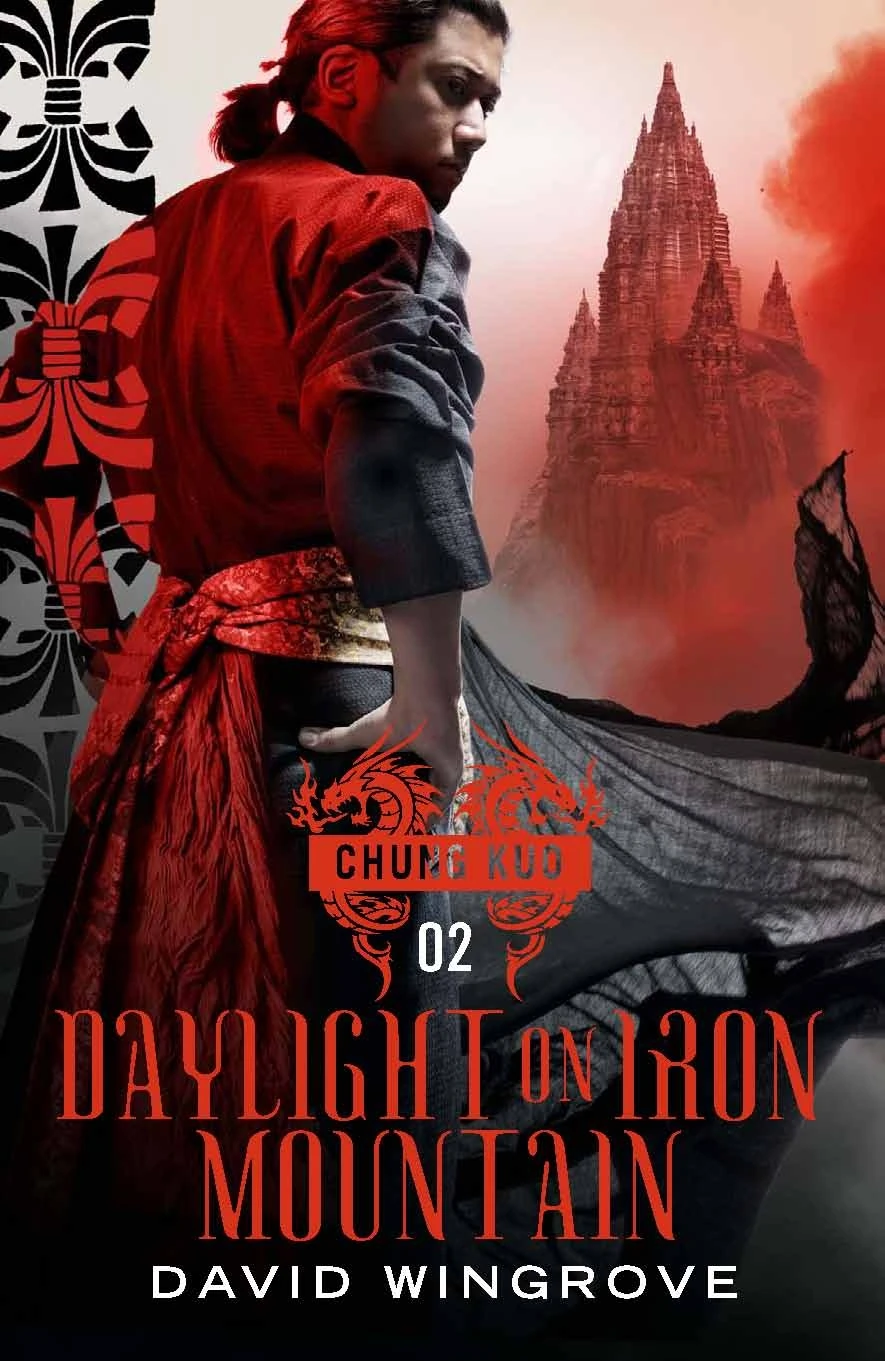
I recently reviewed Book One in this re-imagined Chung-Kuo series by British author David Wingrove, a book called Son of Heaven, which I loved. After putting that book down and having had just a taste of Wingrove’s talent and imagination, I was excited to pick up this second book, Daylight on Iron Mountain. As mentioned in that first review, this second book was a huge let-down.
Where to begin? Apart from the fact that the title of this book has nothing to do with its story, I guess the most annoying aspect of the entire book was the pace with which Wingrove rushes through the story. I understand a focus-shift from one set of character to a new set. In Book One, for example, we had gotten to know the British characters intimately, through both their flashbacks and their recognition that some incredible change was afoot. Then in Book Two, the focus shifts away from these characters (who we had thought important) to the Chinese who have taken over the world. The shift makes sense in a way, yet there’s virtually no information about those wayward peasants to whom we had grown so close in the first installment, and then the pace sets in: suddenly 20 of the most important years sweep by, years which ought to have shown us readers how these people felt about being forced to live within the layers of a plastic world under a new regime of Chinese rulers. How could Wingrove skip all of that, just because his focus-characters have changed!? Where’s the confusion? Where’s the adjustment? Where’s the slow yet inevitable acceptance of this new way of life or the undercurrents of foreign rebellion?
This brings me to a second annoyance: the global “city” made of a unique white plastic should have been a character all itself. Instead, it’s barely discussed and very quickly becomes mere setting. How could Wingrove so quickly ignore the largest and most unique feature of his entire universe, as if his new Planet Earth were some ho-hum alien world? This isn’t a short story where such details can be offered the reader in a sentence or two and then left to the imagination. If readers are going to invest in a fantastic world, it better darn well be fantastic!
Wingrove’s failure to fully update the series is also an obvious failure that makes this second book difficult to read or invest in. Take the technology, for example. Whereas characters in Book One had implants in their heads that allowed them to communicate with others freely, suddenly in China’s advanced culture, everyone is back to using plain ol’ phones—and not just phones, but operators who need to help callers get “put through” to their colleagues.
The action of Book One is also absent and a source of annoyance. While I can understand Wingrove’s desire to lessen the presence of guns in favor of more martial-arts-type violence, the disparity in action between the two books is palpable.
The most annoying aspect of the book, in my opinion, was the inclusion of Jake’s courtroom drama that reminded me of a lame TV show from 1980s. “Who invited Matlock?” was a thought running through my head as I read. Jake in Book One was a likeable, flawed character in his late 40s with a background intricately woven into the fabric of the great apocalypse. He was committed to friends, family, and community, and he wasn’t afraid to get violent in defending them. Jake in Book One was the reluctant hero and one worth following. In Book Two, he’s an 80-year old grouch whose only concern is getting the salary that’s due him, since he’s been such a faithful employee of the Chinese for the past 20 years. Blagh!
I’ll admit that the intrigue and potential coup on the part of the Chinese hierarchy was a nice touch and added some suspense to this book, but not near enough to keep me engaged. If this book moved so quickly to kill off main characters from the first installment to make room for a new plot like this, I don’t want to know what happens in Book Three. Why invest my time in something with such a lousy payoff?
I didn’t give up on this book, and I read it to the end. But I’m giving up on the series and there’s no way I’d ever make it to The End. I’m not telling Mr. Wingrove that his books need a major re-write, but perhaps he should channel his creative talent into something new and fresh rather than ineffectively trying to rehash something that didn’t work too well the first time around.
©2021 E.T.
Read More from David Wingrove:
- Chung Kuo: The Middle Kingdom (1989)
- Son of Heaven (2011)
- Daylight on Iron Mountain (2011)