
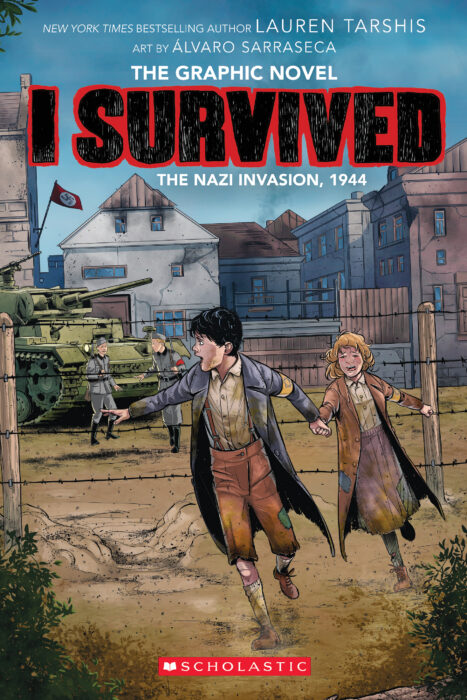
The Graphic Novel adapted by Georgia Ball and illustrated by Alvaro Sarreseca
This book has scratched all my latest itches—WWII-era, survival, graphic novel, and youth-related. I’m so glad that Lauren Tarshis is allowing her hit I Survived series to experience new life in this way, and I hope Graphix continues with the full gamut of books.
I’ve already reviewed a number or Tarshis’ novels like The San Francisco Earthquake of 1906 and The Shark Attacks of 1916, but I’ve only read one other graphic novel in the series, I Survived the Sinking of the Titanic, 1912. I have been impressed by the strong coloration and realistic artistry in each. One quick note about this book’s artwork, though: I was a bit distracted by the constant floaties throughout the books, as if lightning bugs were always buzzing through the storyline or ash were constantly falling from the sky. Not sure why they included these spots, but I wish they had toned it down a bit.
This story follows the experiences of two Jewish children, Max and Zena, as they recount the experiences that led them to be held like prisoners in a camp by the invading Nazi soldiers. The children manage to escape their captors and find protection in the swamps with a brave band of rebels, Jewish and non, which the book’s backmatter identifies as the Bielsky Partisans. This book contains violence and some seriously precarious situations, but its lessons on warfare and survival are real.
I was surprised by the direction this book took, though. It’s not your average war story, just as Anne Frank’s Diary (or The Diary of Anne Frank) is not your average recounting of the Holocaust. Both strongly identify the invading Nazis as the murdering, almost sub-human monsters that they were, but the Nazis are not the star of the show but are merely the backdrop to the human stories of children caught in the mix.
Tarshish writes at the end of this book that she herself is Jewish, and that this book was a hard one for her to write. Still, many of her young fans had written to ask that she write about the Holocaust in some way, and this account of Max and Zena’s escape was her method. This story touches on the evil and the pain of being Jewish in Nazi-controlled Europe, yet it does so in a distant sort of way. She fictionalized the adventure that the children experienced from true history, and in this case, it ends well, yet she also acknowledges that this sort of “happy ending” was a rare result indeed.
The David and Goliath shout-out in the middle of the book was a nice touch, but of course, there was no mention of the Lord (or David’s fighting for the honor of the Lord) in that scene. Instead, the story was used as an illustration of the children’s Aunt Hannah: just as David fought Goliath, so Hannah fights the Nazis. It was a clever way of bringing in a familiar account from Jewish religious history and applying it to the modern times. It’s just too bad that it was so secularized!
I really enjoy reading these books, and I hope that our library continues to pick them up as they’re released. This particular book makes me want to go back and watch the film Defiance (2008) starring Daniel Craig which follows the story of the Bielsky brothers and their Partisans hiding in the woods of Belarus. That one, though, is not for kids.
©2021 E.T.
Read More from Lauren Tarshis:
- I Survived the Shark Attacks of 1916 by Lauren Tarshis (2010)
- I Survived the San Francisco Earthquake, 1906 by Lauren Tarshis (2012)
- I Survived the Sinking of the Titanic, 1912: The Graphic Novel by Lauren Tarshis and Haus Studio (2020)
- I Survived the Shark Attacks of 1916: The Graphic Novel by Lauren Tarshis and Haus Studio (2020)
- I Survived the Nazi Invasion, 1944 by Lauren Tarshis (2021)
I really like the book because it was all about shooting and adventure